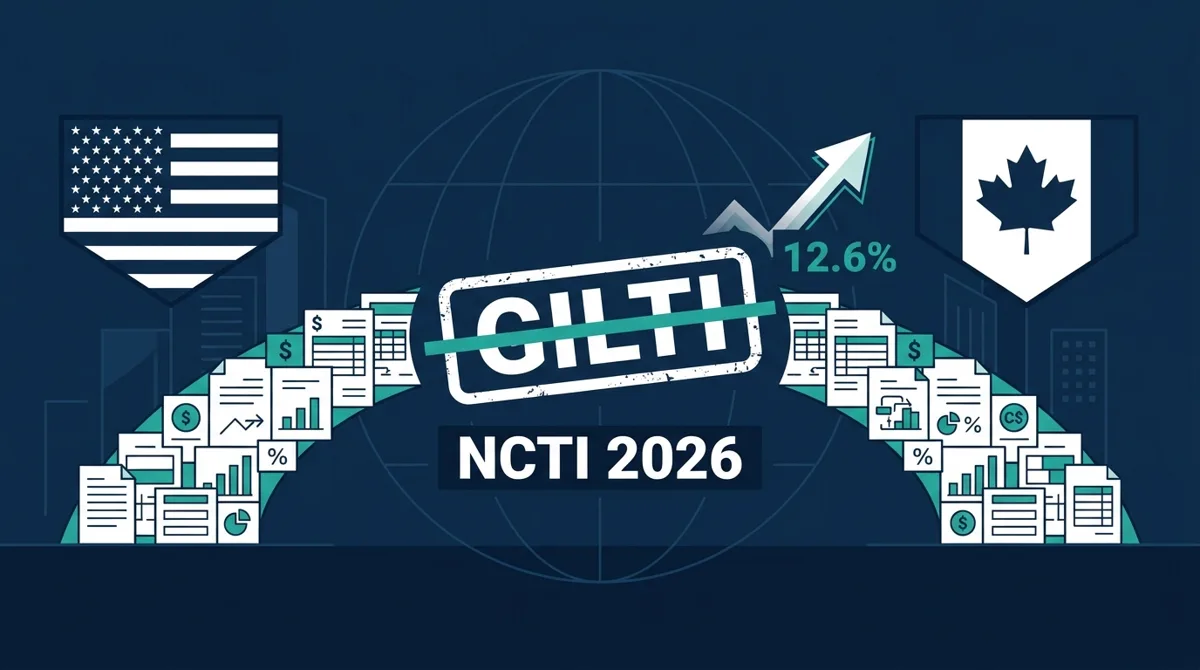
What Actually Changed: GILTI vs NCTI
The mechanics US shareholders of controlled foreign corporations (CFCs) know from GILTI carry over: if US persons owning at least 10% each control more than 50% of your Canadian corporation, its active retained earnings flow through to your US return each year via Form 8992, whether or not you take a dollar out. What changed is how much income is included and what rate applies.
| Feature |
GILTI (through 2025) |
NCTI (from 2026) |
| Section 250 deduction |
50% of inclusion |
40% of inclusion |
| Effective rate (C-corp / §962) |
10.5% |
12.6% |
| QBAI / tangible-asset exclusion |
10% deemed return excluded |
Eliminated |
| Foreign tax credit allowed |
80% of foreign tax |
90% of foreign tax |
| Individual without §962 election |
Ordinary rates, no §250 deduction |
Unchanged — ordinary rates up to 37% |
Why Canadian CCPC Owners Are Hit Hardest
The high-tax exception survives into the NCTI era: if your corporation''s income already bears foreign tax at more than 90% of the US corporate rate — that is, above 18.9% — you can generally elect to exclude it from the regime entirely. This is where the Canadian corporate rate structure creates a trap.
A CCPC''s active business income up to the small business limit is taxed at combined federal-provincial rates of roughly 9% to 13% depending on province — well below the 18.9% threshold. That income cannot use the high-tax exception. Income taxed at the general corporate rate (roughly 23% to 31% combined) clears the threshold comfortably. The result is counterintuitive: the very tax break that makes a CCPC attractive to a Canadian owner — the small business deduction — is what keeps a US owner exposed to annual NCTI inclusions.
The QBAI elimination compounds this. A Canadian corporation holding equipment, vehicles, or real property used in the business could previously shield a deemed 10% return on those assets from GILTI. From 2026, that shield is gone — a construction company, medical practice with an equipped clinic, or manufacturer now has its full tested income in scope.
The Section 962 Math in 2026
For most individual US owners of Canadian corporations, the Section 962 election remains the difference between a manageable tax and a punitive one. The election lets an individual be taxed on the inclusion as if a US corporation received it: the (now 40%) Section 250 deduction applies, and 90% of Canadian corporate tax paid can be credited.
Run the 2026 numbers for a CCPC paying tax at a 12% combined small-business rate: the US tentative tax on the inclusion is 12.6%, and the creditable Canadian tax is 90% of 12% — about 10.8%. The residual US tax is roughly 1.8 percentage points of the inclusion. Without the election, the same income lands on your 1040 at ordinary rates up to 37% with no Section 250 deduction. The election is not automatic — it is made annually on a timely filed return, and distributions out of previously taxed earnings carry their own second-layer rules that need planning.
What to Do Before Year-End 2026
- Re-run your high-tax exception analysis. The threshold moved with the new rate structure, and income that qualified (or didn''t) under GILTI may flip under NCTI — especially if your corporation earns both small-business-rate and general-rate income.
- Revisit salary versus dividends. Paying yourself more salary reduces corporate retained earnings subject to NCTI and is deductible in Canada; the right mix changed when the rate rose to 12.6% and QBAI disappeared.
- Model the Section 962 election for 2026 rather than rolling forward last year''s decision — the 40% deduction and 90% credit change the break-even.
- Owners who relied on QBAI should quantify the hit now. If your corporation is capital-intensive, your 2026 inclusion may be substantially larger than 2025''s at the same profit level.
- Check your compliance stack. Form 5471 and Form 8992 filing obligations continue, with penalties starting at $10,000 per form per year for misses. If you have unfiled years, the Streamlined Filing Procedures remain the cleanest path back.
Frequently Asked Questions
Is NCTI just GILTI with a new name?
No. The forms and CFC framework carry over, but three substantive changes apply from 2026: the Section 250 deduction dropped from 50% to 40% (raising the effective corporate/§962 rate to 12.6%), the QBAI tangible-asset exclusion was eliminated, and the foreign tax credit haircut improved from 80% to 90%.
Does the high-tax exception still exist under NCTI?
Yes. Income taxed abroad above 90% of the US corporate rate — 18.9% — can generally be excluded by election. Canadian general-rate corporate income usually qualifies; small-business-rate CCPC income (roughly 9–13%) usually does not.
I own a Canadian corporation but never filed Form 5471 or 8992. What now?
Penalties start at $10,000 per form per year, but if your non-filing was non-willful you likely qualify for the IRS Streamlined Filing Compliance Procedures — three years of returns and six years of FBARs, penalty-free. Getting this fixed before the IRS''s expanded data-matching finds you is materially cheaper.
Should every US owner of a CCPC make the Section 962 election in 2026?
Usually, but not always — the election interacts with distribution plans, provincial tax rates, and whether your income qualifies for the high-tax exception. It is an annual decision that deserves an annual calculation, not a default.
Own a Canadian corporation as a US person?
The 2026 NCTI rules changed your numbers. Our IRS Enrolled Agents work US-Canada cross-border cases daily — bring your structure to a free 30-minute consultation and we''ll tell you exactly what NCTI means for it.
Book a Free Consultation
Related reading: US Shareholders of Canadian Corporations: CFC and PFIC Rules Explained and our complete US-Canada cross-border tax guide.
This article is general information current as of July 2026, not tax advice for your specific situation. NCTI outcomes depend on your corporation''s income mix, province, and elections — speak with a cross-border tax professional before acting.
Don't miss a filing deadline
Get expat tax deadlines, law changes (like the new 1% remittance tax), and planning moves in a short monthly email from our Enrolled Agents. No spam, unsubscribe anytime.
We Handle Exactly This — Free 15-Minute Strategy Call
Talk to a licensed Enrolled Agent who specializes in US-Canada cross-border tax. No obligation, no sales pitch — just answers to your specific situation.