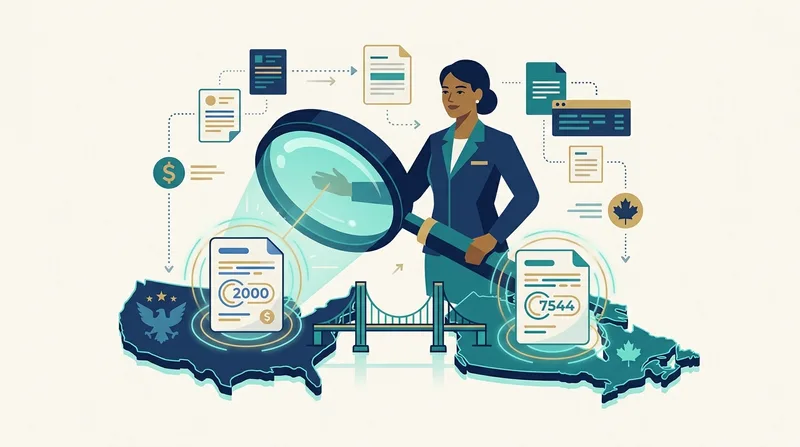
Many dual citizens living in Canada operate under a costly misconception: that claiming the Canada Child Benefit (CCB) disqualifies them from receiving the US Child Tax Credit (CTC). In reality, these two programs are independent of one another, and for many families, they represent a combined annual benefit worth over $9,500 per child. However, securing both requires navigating a minefield of "earned income" definitions, foreign tax credit elections, and rigorous reporting requirements. At Zenith Financial Advisors, we frequently see families leaving thousands of dollars on the table simply because they chose the wrong filing status or failed to coordinate their IRS and CRA filings. As we look toward the 2026 tax year, understanding the synergy between these two systems is the difference between a standard return and a maximized cross-border strategy.
Key Takeaways for 2026
- The US Child Tax Credit remains a cornerstone for expats, offering up to $2,000 per qualifying child under age 17.
- The Canada Child Benefit (CCB) is a tax-free monthly payment that can reach a maximum of $7,544 for children under age six.
- To claim the refundable portion of the US CTC, families must often avoid the Foreign Earned Income Exclusion (FEIE) in favor of Foreign Tax Credits (FTC).
- Compliance with FBAR (FinCEN Form 114) and FATCA (Form 8938) is mandatory if your Canadian accounts cross specific thresholds.
- Coordination of "Adjusted Family Net Income" (Canada) and "Modified Adjusted Gross Income" (US) is essential for accurate benefit calculation.
Understanding the 2026 US Child Tax Credit (CTC)
For the 2026 tax year, the US Child Tax Credit is a vital tool for American expats in Canada. Under current legislation, the credit is worth up to $2,000 per qualifying child. A qualifying child must be under the age of 17 at the end of the tax year and must possess a valid Social Security Number (SSN). For families living abroad, the "refundable" portion—known as the Additional Child Tax Credit (ACTC)—is what allows you to receive a check from the IRS even if you owe zero US taxes.
However, there is a technical hurdle that catches many off guard. According to the IRS, to claim the refundable portion of the credit, you must have "earned income" of at least $2,500. For cross-border taxpayers, the trap lies in how you exclude your Canadian income. If you use Form 2555 (Foreign Earned Income Exclusion), you are legally barred from claiming the refundable Child Tax Credit for that year. Per IRS Publication 501, "you cannot take the child tax credit if you exclude any amount from income... on Form 2555."
Instead, our team at Zenith typically recommends using Form 1116 (Foreign Tax Credit). Since Canadian tax rates are generally higher than US rates, the FTC allows you to eliminate your US tax liability while remaining eligible for the $1,600+ refundable portion of the CTC. This strategy ensures that your Canadian taxes work for you, effectively "unlocking" the cash refund from the IRS.
Source: IRS.gov Publication 501
Maximizing the Canada Child Benefit (CCB)
On the northern side of the border, the Canada Child Benefit (CCB) serves as a tax-free monthly payment made to eligible families to help with the cost of raising children under 18. For the 2024-2025 benefit year (which sets the stage for 2026 adjustments), the maximum benefit is $7,544 per child under age 6 and $6,370 per child aged 6 through 17.
According to the Canada Revenue Agency (CRA), the CCB is strictly based on your Adjusted Family Net Income (AFNI). As your income rises, the benefit gradually phases out. Per the CRA's latest reports, the full benefit is available to families with an AFNI under $36,502. Beyond this threshold, the benefit is reduced by a percentage of the income exceeding the limit.
The beauty of the CCB for dual citizens is its tax status: it is non-taxable in Canada and is not considered "earned income" for US tax purposes. This means it does not increase your US tax liability, nor does it count toward the $2,500 earned income threshold required for the US CTC. According to the Department of Finance Canada, the CCB has played a primary role in reducing child poverty by 50% since its inception, highlighting its significance for resident families.
Source: Canada.ca (CRA)
The Cross-Border Synergy: Real Numbers and Deadlines
To illustrate the power of claiming both, consider a dual-citizen couple living in Ontario with two children (ages 4 and 8) and a combined income of $90,000 CAD.
| Benefit |
Estimated Annual Value |
Filing Requirement |
| US Child Tax Credit |
$4,000 USD |
IRS Form 1040 + Schedule 8812 |
| Canada Child Benefit |
~$9,500 CAD |
CRA Form RC66 + T1 Return |
| Total Family Benefit |
~$15,000+ CAD equiv. |
Coordinated Filings |
Timing is critical. The US tax deadline is April 15, though expats receive an automatic extension to June 15 to file (though any taxes owed are still due by April). The Canadian tax deadline is April 30. According to the IRS, failing to file Form 1040 and Schedule 8812 within three years of the deadline can result in the permanent forfeiture of the refundable credit.
We also must consider the $10,000 FBAR threshold. Per FinCEN guidelines, if the aggregate value of your Canadian bank accounts (including RESPs and TFSAs) exceeds $10,000 USD at any point during the year, you must file FinCEN Form 114. According to FinCEN data, non-willful penalties for failing to report can exceed $15,000 per violation, adjusted for inflation.
Source: FinCEN.gov
PRO TIP: The "Zero-Tax" Refund Strategy
Don't make the mistake of thinking you don't need to file a US return because you don't owe taxes. Many dual citizens in Canada pay more in local tax than they would in the US. By filing Form 1116 to claim Foreign Tax Credits, you can reduce your US tax to zero and still receive a refund check for the Child Tax Credit. This is essentially "free" money from the US Treasury that belongs to your family.
Asset Reporting: FATCA and the $50,000 Threshold
While the CTC and CCB provide significant inflows, the IRS requires strict disclosure of your Canadian assets via Form 8938 (FATCA). This is distinct from the FBAR. For expats living abroad and filing jointly, the threshold for Form 8938 is an aggregate value of $400,000 at year-end (or $600,000 at any point). However, for individuals, that threshold is lower: $200,000 at year-end.
The CRA and IRS share information under the Intergovernmental Agreement (IGA). According to the Treasury Department, this automatic exchange of information makes it nearly impossible to hide Canadian investment accounts or significant CCB-funded savings from the IRS. Ensuring your Form 8938 aligns with your Schedule B and your Canadian T5 slips is a hallmark of professional cross-border compliance.
Furthermore, be wary of the Registered Education Savings Plan (RESP). While a fantastic tool for using CCB funds to save for a child's education in Canada, the IRS views the RESP as a foreign trust. This often requires additional reporting on Forms 3520 and 3520-A. Per IRS guidance, failure to report foreign trusts can result in penalties starting at $10,000 or 35% of the trust's value.
Source: Treasury.gov
Common Mistakes to Avoid
- Using the FEIE (Form 2555) blindly: As mentioned, this is the #1 reason dual citizens miss out on the $2,000 CTC refund. Always run a side-by-side comparison with the Foreign Tax Credit (Form 1116).
- Ignoring the SSN Requirement: You cannot claim the CTC for a child with an ITIN. The child must have a Social Security Number issued before the due date of the tax return.
- Failing to Report CCB Income to the CRA: While the CCB is tax-free, your eligibility depends on filing your Canadian T1 return every year. If one spouse fails to file, the CRA will suspend CCB payments for the entire family.
- Miscalculating the Age Cut-off: The US CTC is for children under 17. The CCB continues until age 18. This one-year gap often causes confusion in family financial planning.
Frequently Asked Questions
Can I claim the Child Tax Credit if my child was born in Canada?
Yes, provided you are a US citizen and have transmitted citizenship to your child. You must first obtain a Consular Report of Birth Abroad (CRBA) and apply for the child's Social Security Number before claiming the credit on your 1040.
Is the Canada Child Benefit taxable on my US tax return?
Generally, no. Under the US-Canada Tax Treaty, social security benefits and similar social welfare payments are often treated as non-taxable, though the CCB specifically is excluded from US gross income because it is a non-taxable governmental benefit.
What if I haven't filed US taxes in years?
You may be eligible for the Streamlined Foreign Offshore Procedures. This allows you to catch up on three years of tax returns and six years of FBARs without penalties, and yes, you can often claim the Child Tax Credit retroactively for those three years.
Do I need a high income to get the $2,000 credit?
No, but you do need at least $2,500 in "earned income" (wages or self-employment income) to qualify for the refundable portion. If your income is very high (over $400,000 for married couples), the credit begins to phase out.
Maximize Your Family's Cross-Border Wealth
Don't leave thousands of dollars in family benefits on the table. Our expert team at Zenith Financial Advisors specializes in navigating the complex intersection of IRS and CRA regulations to ensure you get every dollar you're entitled to.
Internal Links: Our Tax Services | Expat Tax Guide
We Handle Exactly This — Free 15-Minute Strategy Call
Talk to a licensed Enrolled Agent who specializes in US-Canada cross-border tax. No obligation, no sales pitch — just answers to your specific situation.