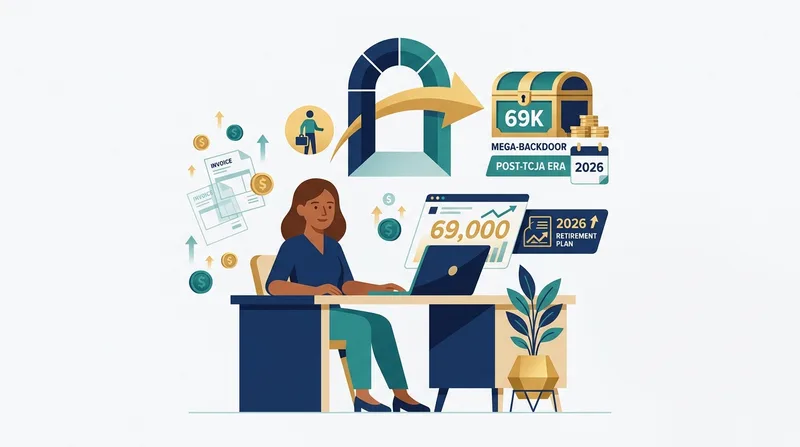
Deconstructing the $69,000 Solo 401k Architecture
The term "Mega Backdoor" sounds like a loophole, but it is actually a precise application of three different contribution "buckets" within a Solo 401k plan. To execute this, your plan document must specifically allow for "voluntary after-tax contributions" and "in-service distributions" or "intra-plan conversions." For 2024, the total defined contribution limit under IRS Section 415(c)(1)(A) is $69,000 (increasing to $70,000 in 2025).
Most self-employed individuals only use the first two buckets:
- Employee Deferral: Up to $23,000 (plus $7,500 if age 50+) which can be Pre-tax or Roth.
- Employer Profit Sharing: Up to 25% of net self-employment income (compensation), usually capped at a total including the employee deferral.
- Voluntary After-Tax: This is the "Mega" component. It allows you to fill the gap between your first two contributions and the $69,000 ceiling.
Per IRS Notice 2024-02, which provides guidance on the SECURE 2.0 Act, the ability to designate employer contributions as Roth further enhances this landscape. However, the true power lies in the after-tax bucket because it is not restricted by the 25% compensation limit in the same way profit-sharing is. As long as you have the earned income to cover the contribution, you can maximize that $69,000 limit regardless of whether your business profit is $150,000 or $500,000.
| Feature |
Standard Solo 401k |
Mega Backdoor Solo 401k |
| Total Limit (2024) |
$69,000 |
$69,000 |
| Roth Component |
Limited to $23,000 |
Up to full $69,000 |
| After-Tax Bucket |
No |
Yes |
| Complexity |
Low |
Moderate/High |
Source: IRS.gov - Retirement Topic Limits
The Cross-Border Twist: US/Canada Tax Treaty Implications
For our clients operating between the US and Canada, the Mega Backdoor Roth strategy requires an extra layer of diligence. One of the most common questions we receive at Zenith is: "Will the CRA recognize my Roth 401k as tax-exempt?" Under Article XVIII of the US-Canada Tax Treaty, pension and retirement plans are generally granted reciprocal recognition. However, the CRA (Canada Revenue Agency) has specific views on what constitutes a "qualified" contribution.
Per the Canada-US Tax Treaty, Article XVIII(7), contributions to a US retirement plan by a Canadian resident may be deductible in Canada if the plan is generally corresponding to a Canadian registered plan. While a Roth 401k doesn't provide a deduction in Canada, its growth is generally tax-deferred. The critical step for cross-border professionals is ensuring that you do not trigger a "contribution to a foreign trust" issue. Most Solo 401k plans are considered employee benefit trusts, but if you are a dual-taxpayer, you must be wary of Form 3520 and Form 3520-A if the plan is misclassified. Fortunately, standard 401k plans are usually exempt from these specific foreign trust filings under IRS Revenue Procedure 2020-17, but the distinction is vital for compliance.
Furthermore, the FinCEN Form 114 (FBAR) and IRS Form 8938 thresholds apply. If your Solo 401k is held in a brokerage account and you are a US citizen living in Canada, the value of that account must be reported if you exceed the $10,000 (FBAR) or $50,000+ (Form 8938) thresholds. According to FinCEN data, FBAR violations can carry non-willful penalties exceeding $16,000 per violation, making meticulous reporting as important as the tax strategy itself.
PRO TIP: The "Immediate Conversion" Rule
To make the Mega Backdoor truly effective, you must convert your voluntary after-tax contributions to Roth 401k (or Roth IRA) as soon as they hit the account. If you leave the funds in the after-tax bucket, the earnings on those funds will be taxable upon withdrawal. By converting immediately, you ensure that 100% of the future growth is tax-free. Most high-end 401k providers now offer automated "daily Roth conversions" to handle this for you.
Navigating Deadlines and Form Compliance
The success of a Mega Backdoor strategy is entirely dependent on the calendar. For a Solo 401k, the plan must be established by December 31 of the tax year to allow for employee deferrals, although SECURE Act 2.0 now allows some employer-side contributions to be set up by the tax filing deadline (including extensions). However, if you want to utilize the voluntary after-tax component for a given year, we strongly recommend having your plan documents and accounts active well before the fourth quarter.
When it comes to reporting, the IRS tracks these movements through Form 1099-R. When you move money from the after-tax bucket to the Roth bucket (the "backdoor" move), your plan custodian will issue a 1099-R. Even if the transaction is non-taxable, it must be reported on your Form 1040. Per IRS Publication 575, failure to correctly report a rollover or conversion can lead to the IRS treating the entire distribution as taxable income until proven otherwise.
Additionally, for the self-employed, these contributions affect your Schedule C or Form 1120-S calculations. While employee deferrals and after-tax contributions don't reduce your business's gross income, employer profit-sharing contributions do. Balancing these buckets requires a bird's-eye view of your entire tax return—a service we specialize in at Zenith Financial Advisors.
Common Mistakes to Avoid
- Using a "Basic" Plan: Most "free" Solo 401k plans offered by major discount brokerages do not allow for voluntary after-tax contributions. You usually need a customized "prototype" plan document to enable the Mega Backdoor.
- Exceeding Earned Income: You cannot contribute more than you earn. If your business has a net loss or very low profit (after deducting the employer portion of SE tax), you cannot "fund" the $69,000 from personal savings.
- Ignoring the Pro-Rata Rule (in IRAs): While the Solo 401k Mega Backdoor is generally isolated from your IRAs, if you try to do a standard Backdoor Roth IRA while holding large SEP-IRA or Simple IRA balances, you will trigger the IRS pro-rata rule. Keeping your funds in a Solo 401k environment helps avoid this trap.
- Missing the FBAR/8938: For our cross-border clients, forgetting that a US-based Solo 401k is a reportable asset to the CRA (and vice versa for US residents with Canadian assets) can lead to draconian penalties.
Frequently Asked Questions
Can I do a Mega Backdoor Roth if I have employees?
Technically, yes, but it is no longer a "Solo" 401k. If you have full-time employees (over 1,000 hours), you must include them in the plan, and you will be subject to non-discrimination testing (ADP/ACP tests), which often makes the Mega Backdoor impossible for the owner unless the employees also contribute significantly.
Is the $69,000 limit per person or per business?
It is per person, per year. If you and your spouse both work in the business, you could potentially shelter $138,000 ($69,000 x 2) into Roth accounts annually. This is one of the most powerful wealth-building tools available to married entrepreneurs.
What happens to the Mega Backdoor after 2026?
While Section 199A (QBI) is scheduled to sunset, the rules governing 401k contributions and Roth conversions are not currently scheduled to expire. This makes the Mega Backdoor a more stable, long-term planning tool than the QBI deduction.
Do I need to file a Form 5500-EZ?
Per IRS instructions for Form 5500-EZ, you only need to file if your total plan assets (including your spouse's) exceed $250,000 at the end of the year. Once you cross that threshold, filing is mandatory and the penalties for missing it are severe—$250 per day, up to $150,000.
Ready to Shield Your Income Before the 2026 Cliff?
The intersection of cross-border compliance and high-level tax strategy is where Zenith Financial Advisors excels. Don't wait until Section 199A expires to start building your tax-free fortress.
Explore our Full Range of Services or learn more about Expat Tax Specialties.
We Handle Exactly This — Free 15-Minute Strategy Call
Talk to a licensed Enrolled Agent who specializes in US-Canada cross-border tax. No obligation, no sales pitch — just answers to your specific situation.