Strategy 1: The S-Corp Pivot and Reasonable Compensation
When the QBI deduction was in full effect, the advantage of an S-Corp over a sole proprietorship was often marginal for those earning under $150,000. However, in a post-QBI world, the S-Corp becomes the primary tool for tax mitigation. By electing S-Corp status (using Form 2553), you can split your income into two categories: a W-2 salary and shareholder distributions.
Only the W-2 salary is subject to the 15.3% self-employment tax (FICA). The remaining profit—the distributions—is exempt from these payroll taxes. While the IRS requires you to pay yourself a "reasonable compensation," the savings on the distribution side can easily offset the loss of the QBI deduction. For example, if you earn $250,000 and pay yourself a reasonable salary of $120,000, you avoid self-employment tax on the remaining $130,000, potentially saving over $15,000 in taxes.
Expert guidance is critical here. As noted in IRS Revenue Ruling 74-44, the IRS has the authority to recharacterize distributions as wages if the salary is deemed too low. We work with our clients to perform a formal "Reasonable Compensation Study," utilizing Bureau of Labor Statistics data and industry benchmarks to ensure your salary withstands IRS scrutiny while maximizing your tax savings.
| Income Type |
Sole Proprietor (2026) |
S-Corp Election (2026) |
| Business Profit |
$250,000 |
$250,000 |
| Subject to SE Tax |
$250,000 |
$120,000 (Salary) |
| Self-Employment Tax Savings |
$0 |
Approx. $15,000+ |
Strategy 2: Maximizing the Solo 401(k) and Defined Benefit Plans
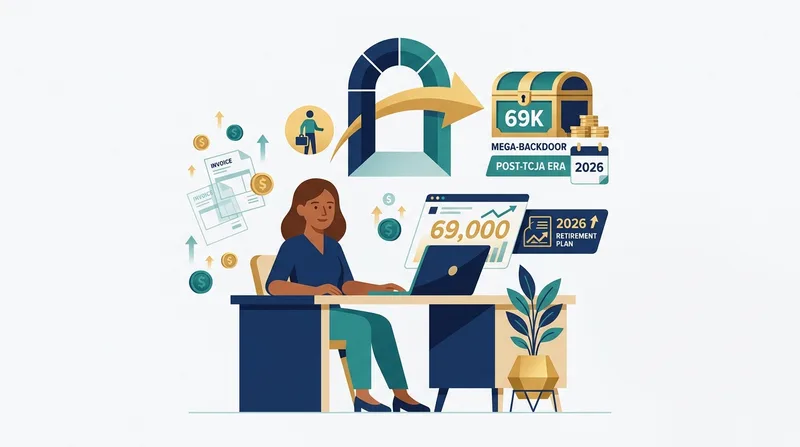
If you can no longer deduct 20% of your income off the top, the next best strategy is to hide that income in tax-advantaged retirement vehicles. For the self-employed, the Solo 401(k) is a powerhouse. In 2024, the contribution limit is $69,000 (or $76,500 if over age 50), and these limits are expected to rise with inflation by 2026.
By contributing the maximum amount to a Solo 401(k), you are effectively reducing your taxable income on a dollar-for-dollar basis. According to IRS Publication 560, these contributions must be made by the tax filing deadline (including extensions) to count for the previous year. For those earning consistently over $250,000, we often recommend layering a Defined Benefit Plan on top of a 401(k). This can allow business owners to stash away upwards of $150,000 or more annually, depending on age and income levels.
"The expiration of Section 199A forces a shift from 'automatic' deductions to 'intentional' ones," says our senior tax strategist. "Retirement planning is no longer just for the future; it is the most potent tax-shielding tool available for 2026 and beyond." We help you navigate the complex actuarial calculations required for these plans to ensure compliance with Treasury Regulation 1.401(a)(4).
Strategy 3: Leveraging Section 179 and Bonus Depreciation Shifts
Another significant change occurring alongside the QBI sunset is the phase-out of bonus depreciation. Under the TCJA, businesses could deduct 100% of the cost of eligible equipment in the year of purchase. However, that rate dropped to 60% in 2024, 40% in 2025, and will hit 20% in 2026 before disappearing entirely in 2027.
To pivot, self-employed professionals must become experts in Section 179 expensing. Unlike bonus depreciation, Section 179 allows you to deduct the full purchase price of qualifying equipment and software up to a specific limit (which was $1.22 million in 2024 per IRS Revenue Procedure 2023-34). This deduction is limited to your taxable business income, meaning it cannot create a net operating loss (NOL), unlike bonus depreciation.
Strategic timing of capital expenditures is vital. If you need new technology, vehicles, or equipment, purchasing and placing them in service before the 2025 year-end might capture a higher bonus depreciation percentage, but for 2026, Section 179 will be your primary mechanism for accelerating deductions. We advise our clients to keep a rigorous asset ledger to ensure that every possible "qualified improvement property" is identified and expensed appropriately under the current Internal Revenue Code guidelines.
Source: IRS.gov
Strategy 4: Cross-Border Optimization for Expats and Digital Nomads
For our cross-border clients, the end of the QBI deduction creates a unique set of challenges. Many expats have been using a combination of the Foreign Earned Income Exclusion (FEIE) via Form 2555 and the QBI deduction to bring their U.S. tax liability near zero. However, the QBI deduction is only available for income that is NOT excluded via the FEIE.
In 2026, many self-employed expats may find that switching from the FEIE to the Foreign Tax Credit (FTC) via Form 1116 is more advantageous. If you are living in a high-tax jurisdiction (like many parts of Europe or Canada), the FTC allows you to credit the taxes paid to your host country against your U.S. tax liability. Since the QBI deduction is no longer there to lower your U.S. tax, the dollar-for-dollar credit of the FTC often provides a better outcome.
Furthermore, per FinCEN and IRS reporting requirements, cross-border business owners must remain vigilant about FBAR (FinCEN Form 114) and FATCA (Form 8938) reporting. According to IRS data, over 12,000 FBAR-related civil penalties were assessed in recent years for non-compliance. As tax rates rise in 2026, the IRS is expected to increase enforcement on international holdings to close the "tax gap." Our team specializes in harmonizing these international filings with your 2026 domestic tax strategy.
Source: IRS SOI Report
PRO TIP: The "Accountable Plan" Advantage
Most self-employed people neglect the power of an Accountable Plan. By formalizing how your business reimburses you for home office, travel, and meals, you turn these expenses into a direct reduction of your S-Corp's gross income. This is far more effective than taking them as itemized deductions, which are often limited. In 2026, an Accountable Plan is your best defense against the 15.3% self-employment tax on the dollars you spend just to stay in business.
Common Mistakes to Avoid in the 2026 Transition
- Ignoring the March 15 S-Corp Deadline: Many business owners decide to pivot too late. To be treated as an S-Corp for the 2026 tax year, Form 2553 must be filed by March 15, 2026. Missing this deadline can cost you an entire year of tax savings.
- Miscalculating "Reasonable Compensation": Setting your salary too low to avoid FICA taxes is the fastest way to trigger an audit. Per the GAO, S-Corp audits often focus exclusively on shareholder compensation levels.
- Failing to Adjust Quarterly Estimates: Because the QBI deduction automatically lowered your taxable income, your safe harbor estimates for 2026 will likely be underfunded. Failure to increase your Form 1040-ES payments can result in significant underpayment penalties.
Frequently Asked Questions
Will Congress extend the QBI deduction before 2026?
While there is political pressure to extend Section 199A, current budget constraints and the legislative calendar make an extension uncertain. We always advise planning for the "law as it stands" rather than banking on a last-minute Congressional save. If they do extend it, your proactive planning (like S-Corp status) will often still be beneficial.
Does the QBI sunset affect C-Corporations?
No. The QBI deduction only applied to pass-through entities (Sole Proprietors, LLCs, Partnerships, S-Corps). C-Corporations have a flat 21% tax rate that was made permanent by the TCJA. However, C-Corps face "double taxation" on dividends, which is why we usually analyze the S-Corp route first for our self-employed clients.
Can I still claim QBI on my 2025 taxes?
Yes, the deduction remains fully available for the 2024 and 2025 tax years. The expiration only affects income earned starting January 1, 2026. This gives you a two-year window to restructure your business and implement the strategies mentioned above.
Does the loss of QBI affect my state taxes?
It depends on your state. Some states (like New York) did not allow the QBI deduction anyway, while others "coupled" their tax code to the federal code and allowed it. You will need to check with a tax professional to see how your specific state handles the federal sunset of Section 199A.
Don't Wait for the 2026 Tax Cliff
Our team at Zenith Financial Advisors specializes in helping high-earning self-employed professionals protect their income through major legislative shifts. Schedule your strategy session today to ensure your business structure is optimized for the post-QBI era.
Schedule Your Free Consultation
Call us today: +1 (409) 916-8209