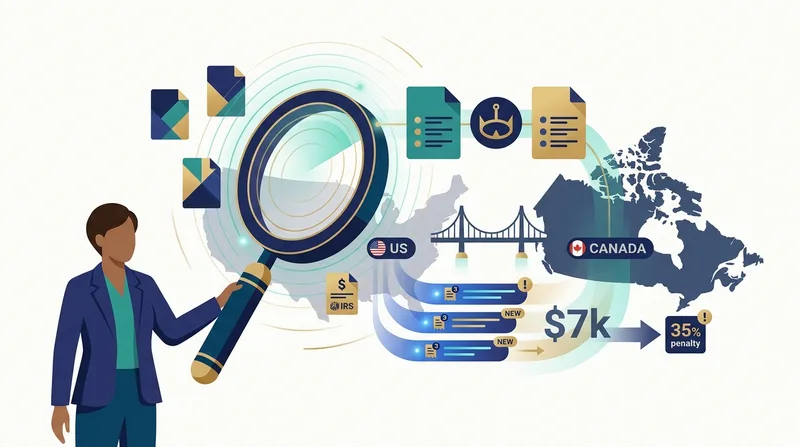
Think of the Tax-Free Savings Account (TFSA) as a Trojan Horse for the US-Canadian expat. To the Canada Revenue Agency (CRA), it is a pristine, tax-sheltered vehicle designed to help you grow wealth effortlessly. But to the Internal Revenue Service (IRS), that same $7,000 contribution you made for 2024, 2025, or 2026 isn't just a savings account—it is potentially a 'Foreign Trust' or a 'Passive Foreign Investment Company' (PFIC) nightmare. At Zenith Financial Advisors, we see hundreds of dual citizens every year who believe their TFSA is 'tax-free' because of the name, only to realize the IRS treats every penny of gain as taxable income, often at the highest marginal rates, while demanding complex filings that carry penalties starting at $10,000 per year. As we head into the 2026 tax season, the stakes have never been higher due to increased IRS digital surveillance and the expiration of certain lenient enforcement postures.
Key Takeaways for 2026 Compliance
- The PFIC Trap: Most Canadian mutual funds and ETFs held in a TFSA are classified as PFICs, requiring Form 8621 and potentially being taxed at rates exceeding 50% when interest is included.
- Form 3520 Risk: While some practitioners argue a TFSA is a custodial account, the IRS has not issued a formal Revenue Procedure exempting it from Foreign Trust reporting (Forms 3520 and 3520-A).
- $10,000 Minimum Penalty: Failure to report a foreign account (FBAR) or a foreign trust can trigger automatic penalties regardless of whether tax was actually owed.
- FATCA Reporting: Under the Foreign Account Tax Compliance Act, Canadian banks automatically report your TFSA balance to the IRS, making 'hiding' the account impossible.
1. The 2026 Reality: Why the $7,000 Limit Is a Double-Edged Sword
For the 2024, 2025, and now 2026 tax years, the CRA has maintained or increased the annual TFSA contribution limit (currently $7,000 per year, with cumulative room often exceeding $100,000 for long-term residents). While our team at Zenith celebrates Canadian tax efficiency, we must warn US citizens that the IRS does not recognize the 'Tax-Free' status of these accounts. Under the Canada-U.S. Income Tax Treaty, RRSPs are specifically protected and tax-deferred for US purposes. TFSAs, which were created long after the treaty was signed, enjoy no such protection.
According to the Internal Revenue Service (IRS), any income earned within a TFSA—whether interest, dividends, or capital gains—must be reported on your Form 1040. If you earn $1,000 in dividends inside your TFSA, you owe US tax on that $1,000 in the year it is earned. Because there is no Canadian tax paid on this income, you cannot use Foreign Tax Credits (Form 1116) to offset the US liability. This leads to 100% double taxation on the growth of your investments.
Source: IRS.gov - United States Income Tax Treaties
Furthermore, the IRS has ramped up enforcement. Per the IRS Inflation Reduction Act Strategic Operating Plan (2023-2031), the agency is investing billions into AI-driven data matching. This means the IRS can now more easily cross-reference the FATCA data sent by Canadian banks (like RBC, TD, and BMO) with your individual tax returns. If a bank reports a TFSA in your name but you haven't filed a Form 8938 or reported the income, a 'soft letter' or a full audit is likely to follow by 2026.
2. The PFIC Nightmare: Form 8621 and the 37% Tax Rate
The most devastating aspect of the TFSA for US citizens isn't just the tax on income—it's how that income is taxed if you hold Canadian mutual funds or ETFs. Most Canadian-domiciled pooled investments are classified by the IRS as Passive Foreign Investment Companies (PFICs). Reporting these requires IRS Form 8621, which the IRS itself estimates takes approximately 20 to 40 hours per fund to complete correctly.
If you do not make a 'Qualified Electing Fund' (QEF) or 'Mark-to-Market' election in the first year of ownership, you are subject to the Section 1291 Excess Distribution regime. Under this rule:
- Gains are 'smoothed' over your entire holding period.
- The portion of the gain attributed to prior years is taxed at the highest marginal tax rate for that year (currently 37% at the federal level), regardless of your actual income bracket.
- The IRS charges compounded interest on the 'deferred' tax for every year you held the investment.
According to research published in the Tax Notes International journal, the effective tax rate on a PFIC held for 10 years can exceed 50-60% of the total gain. We often tell our clients: if you are a US citizen, your TFSA should only hold individual stocks or US-listed ETFs (though the latter can trigger other Canadian tax issues), or better yet, avoid the TFSA for high-growth investments entirely.
Source: IRS.gov - Instructions for Form 8621
3. Is Your TFSA a Foreign Trust? The 35% Penalty Trap
There is a long-standing debate among cross-border tax professionals: is a TFSA a 'Foreign Trust' for US tax purposes? If it is, you must file IRS Form 3520 (Annual Return To Report Transactions With Foreign Trusts) and Form 3520-A (Annual Information Return of Foreign Trust With a U.S. Owner).
The penalty for failing to file Form 3520 is the greater of $10,000 or 35% of the gross value of the assets transferred to the trust. While Revenue Procedure 2020-17 provided some relief for 'certain tax-favored foreign retirement trusts' (like RESPs and RDSPs), it conspicuously left out the TFSA. Many conservative firms, including ours, carefully evaluate each client's TFSA structure. If your TFSA is set up as a formal trust agreement with a trustee (common in some brokerage-held TFSAs), the IRS could easily argue it falls under the 3520 reporting requirement.
| Requirement |
Threshold / Deadline |
Potential Penalty |
| FBAR (FinCEN 114) |
$10,000 (Aggregate) |
$16,117+ (Non-willful) |
| Form 8938 (FATCA) |
$200,000+ (Living abroad) |
$10,000 per violation |
| Form 3520 |
Any TFSA contribution/value |
35% of account value |
| Form 8621 (PFIC) |
Any value (no de minimis for excess dist.) |
Tax at 37% + Interest |
Per FinCEN data, the number of FBAR filings has increased by over 20% in the last five years as more expats become aware of their obligations. However, the IRS continues to assess penalties aggressively. In 2023, the Supreme Court case Bittner v. United States limited non-willful FBAR penalties to $10,000 per report rather than per account, but this does not protect you from the 35% penalties associated with Foreign Trust reporting (Form 3520).
Source: FinCEN.gov - Reporting Statistics
4. Strategic Alternatives: Moving Beyond the TFSA
Our team often recommends that US citizens in Canada look for alternative ways to save. If the goal is long-term retirement savings, the RRSP (Registered Retirement Savings Plan) remains the gold standard. Under Article XVIII(7) of the US-Canada Tax Treaty, the IRS allows for the deferral of tax on income earned within an RRSP until it is distributed. No Form 3520 or Form 8621 is required for RRSPs.
Another emerging option is the FHSA (First Home Savings Account). While its US tax treatment is still being debated by practitioners (as it is also not technically in the treaty), many believe it may fall under the same relief as RESPs under Rev. Proc. 2020-17. However, until the IRS issues specific 2026 guidance, the FHSA should be approached with the same caution as a TFSA.
For those with extra liquidity, a standard Taxable Brokerage Account is often more tax-efficient than a TFSA. Why? Because the Canadian taxes you pay on capital gains and dividends in a taxable account can be used as Foreign Tax Credits on your US return, often reducing your US tax liability on that income to zero. In a TFSA, you lose that credit entirely.
PRO TIP: The "Individual Stock" Strategy
If you insist on keeping a TFSA, avoid mutual funds and ETFs entirely. By holding individual stocks (e.g., Apple, Royal Bank, Shopify), you avoid the PFIC reporting nightmare of Form 8621. You will still owe US tax on the dividends and gains, but you avoid the punitive 'excess distribution' tax rates and the massive cost of specialized accounting for PFICs.
Common Mistakes to Avoid
- The "Name Only" Fallacy: Assuming that because Canada calls it "Tax-Free," the IRS must agree. The IRS does not respect the tax-exempt status of foreign accounts unless specifically noted in a treaty.
- Missing the April 15/June 15 Deadlines: While expats get an automatic extension to June 15 to file, any tax owed is due by April 15. Interest begins accruing on April 16, even if you are living in Toronto or Vancouver.
- Neglecting FBAR: Even if your TFSA is empty but was once over $10,000 (combined with other accounts like your chequing or savings), you must report it. The $10,000 threshold is the aggregate of all foreign accounts at their highest point during the year.
- DIY PFIC Reporting: Attempting to fill out Form 8621 without specialized software or professional help. One small error in the cost-basis calculation can lead to years of back-taxes and interest.
Frequently Asked Questions
Should I close my TFSA immediately?
Not necessarily, but you should evaluate the contents. If you hold PFICs (mutual funds/ETFs), the cost of compliance and the high tax rate often outweigh the benefits. If you hold only cash or individual stocks, the burden is lower, but you are still losing the benefit of tax-free growth since the IRS will tax it.
What if I haven't reported my TFSA for years?
You may qualify for the Streamlined Domestic or Foreign Offshore Procedures. This is an IRS amnesty program that allows you to catch up on three years of tax returns and six years of FBARs with reduced or waived penalties, provided your failure to report was non-willful.
Does the $7,000 contribution limit increase my penalty risk?
Mathematically, yes. Higher account values lead to higher potential penalties for Form 3520 (35% of the value) and Form 8938. As your TFSA grows, it becomes a larger target for IRS automated matching systems.
Can I use Form 2555 (Foreign Earned Income Exclusion) to cover my TFSA gains?
No. Form 2555 only applies to earned income (wages or self-employment income). Gains, dividends, and interest from a TFSA are passive income and cannot be excluded using this form.
Stop the TFSA Tax Bleeding
Don't let a $7,000 contribution turn into a $10,000 penalty. Our team of cross-border specialists can help you clean up your TFSA reporting or transition your wealth to US-compliant structures before the 2026 tax season.
Schedule Your Free Consultation
Call us today: +1 (409) 916-8209
We Handle Exactly This — Free 15-Minute Strategy Call
Talk to a licensed Enrolled Agent who specializes in US-Canada cross-border tax. No obligation, no sales pitch — just answers to your specific situation.