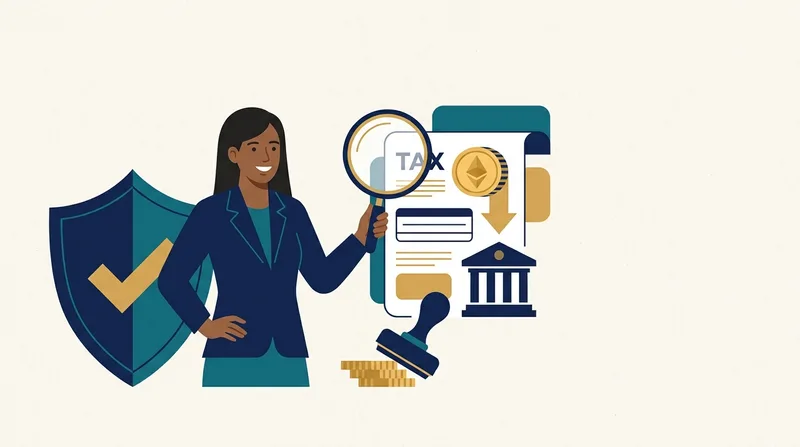
For years, the prevailing myth among digital asset holders was that crypto operated in a 'black box'—invisible to the IRS and shielded from the prying eyes of the Treasury. However, that veil of anonymity has officially been lifted. Starting in 2026, for transactions occurring in 2025, the IRS is introducing Form 1099-DA, a dedicated tax form that turns every major crypto exchange and 'hosted wallet' provider into a federal informant. According to the IRS, the tax gap—the difference between taxes owed and taxes paid—attributable to digital assets is estimated to be billions of dollars annually. With the Infrastructure Investment and Jobs Act now in full swing, our team at Zenith Financial Advisors is seeing the most significant shift in tax compliance since the introduction of the FBAR. If you move $10,000 in crypto or fail to track your cost basis correctly, you aren't just looking at a clerical error; you are facing a potential IRS audit and a minimum non-compliance fine of $2,500 per violation.
Key Takeaways for the 2026 Tax Season
- The Arrival of Form 1099-DA: Brokers must now report gross proceeds and cost basis for digital asset sales directly to the IRS.
- The $10,000 Reporting Trigger: Under Section 6050I, businesses receiving more than $10,000 in digital assets must report the transaction within 15 days.
- Cost Basis Burden: If your broker doesn't have your historical data (common with self-custody), the IRS may default your cost basis to $0, maximizing your tax bill.
- International Complexity: Cross-border holders must reconcile 1099-DA data with Form 8938 and FBAR (FinCEN Form 114) to avoid overlapping penalties.
1. Understanding Form 1099-DA: The New Standard for Digital Asset Reporting
In mid-2024, the Treasury Department and the IRS finalized Treasury Decision 10000 (TD 10000), which officially defines who is a 'broker' in the digital asset space. This isn't just about Coinbase or Kraken. The definition extends to any platform that facilitates the exchange of digital assets for cash, different digital assets, or services. Starting with the 2025 tax year (reported in 2026), these entities will issue Form 1099-DA (Digital Assets).
Our team has analyzed these regulations extensively. The primary goal of the 1099-DA is to eliminate 'taxpayer-reported basis' where individuals could essentially choose which price they bought Bitcoin at to lower their gains. Now, the broker will report the 'Gross Proceeds' and, for 'covered' securities, the 'Adjusted Basis.' If you transferred assets from a cold wallet (like a Ledger or Trezor) into an exchange to sell, that exchange will likely have no record of your original purchase price. Without proactive documentation, the IRS will assume your basis is zero.
As IRS Commissioner Danny Werfel stated during the release of the final regulations, 'These regulations are designed to provide taxpayers and the IRS with the information they need to ensure that everyone plays by the same rules and that tax laws are applied fairly.' This marks the end of the 'honor system' for crypto reporting.
Source: IRS.gov
2. The $10,000 Threshold: Why 'Wallet Audits' Are the New Reality
A major point of confusion for our self-employed and small business clients is the amendment to Internal Revenue Code Section 6050I. Historically, businesses were required to file Form 8300 when receiving more than $10,000 in cash. The Infrastructure Act expanded this to include digital assets. If you are a consultant, developer, or shop owner and you receive a payment of $10,500 in ETH, you must report the sender's name, address, and Social Security Number to the IRS within 15 days.
Failure to comply with these reporting requirements can be catastrophic. The civil penalty for failing to file a correct information return is $250 per return, but if the failure is due to 'intentional disregard,' the fine jumps to the greater of $25,000 or the amount of the transaction. For most small errors, the standard non-compliance fine for incorrect 1099 reporting hovers around $2,500 per year when aggregated, but the 'Wallet Audit' risk is higher. The IRS uses data-matching algorithms to compare your 1099-DA entries against your reported income on Form 1040, Schedule D.
We advise our clients to treat every large crypto transfer with the same scrutiny as a bank wire. Per FinCEN guidelines, any transaction that appears to be 'structured' to avoid the $10,000 threshold (e.g., two transfers of $5,500) can trigger a criminal investigation for structuring, a felony offense.
Source: FinCEN.gov
3. Cross-Border Complications: Expats and the IRS/CRA Nexus
For our clients living between the US and Canada, crypto presents a double-edged sword. The Canada Revenue Agency (CRA) has also stepped up its enforcement through the 'Crypto-Asset Reporting Framework' (CARF). In the US, if you hold crypto on a foreign exchange (like Binance or a local Canadian exchange), you may have multiple filing requirements beyond just the 1099-DA.
| Requirement |
Threshold |
IRS Form |
| FBAR (Foreign Bank Account) |
$10,000 (aggregate) |
FinCEN Form 114 |
| FATCA Reporting |
$50,000+ (varies) |
Form 8938 |
| Broker Reporting |
Any Sale/Exchange |
Form 1099-DA |
The IRS recently clarified that while digital assets held in a private wallet are not currently reportable on an FBAR (per FinCEN Notice 2020-2), assets held on a foreign exchange likely are. According to FinCEN data, FBAR non-willful penalties can reach up to $16,117 per violation (adjusted for inflation). If the 1099-DA shows you received $20,000 from a foreign source and you failed to file an FBAR or Form 8938, you have effectively provided the IRS with the roadmap for your own audit.
Our team works to ensure that your Foreign Earned Income Exclusion (Form 2555) and Foreign Tax Credits (Form 1116) are optimized so that you aren't double-taxed on crypto gains realized while living abroad.
Source: FinCEN.gov
4. The Burden of Proof: Reconciling Self-Custody and 'Wash Sales'
One of the most dangerous traps in the 2026 'Wallet Audit' environment is the lack of information sharing between wallets. If you buy 1 BTC on Exchange A and transfer it to a cold wallet, then two years later transfer it to Exchange B to sell, Exchange B will report the sale on Form 1099-DA with a 'missing' or 'zero' cost basis. We cannot stress this enough: The burden of proof rests entirely on the taxpayer.
Furthermore, the IRS is closing in on the 'Wash Sale' loophole for crypto. While Section 1091 currently applies primarily to stocks and securities, the Treasury has signaled in its Greenbook proposals that it intends to apply these rules to digital assets. This would mean you could no longer sell your Bitcoin at a loss to offset other gains and immediately buy it back. Even if the law hasn't fully transitioned by the 2026 filing season, the Form 1099-DA will provide the IRS with the granular timestamp data needed to retroactively challenge these trades if the Economic Substance Doctrine is applied.
Per Treasury Department guidelines, taxpayers are required to maintain records that 'establish the amount of any deductions, credits, or other matters' shown on their returns. For crypto, this means keeping a synchronized log of every wallet-to-wallet transfer to prove that a transfer wasn't a taxable sale.
PRO TIP: Do not rely on exchange-generated CSV files alone. Exchanges frequently go bankrupt (e.g., FTX, Celsius) or change their reporting formats. We recommend using a dedicated sub-ledger software that integrates with your wallets and exchanges via API. This creates a 'permanent record' that can withstand an IRS crypto audit even if the exchange you used no longer exists.
Common Mistakes to Avoid
- Treating Transfers as Sales: Many taxpayers mistakenly report wallet-to-wallet transfers as taxable events. This inflates your gross proceeds on the 1099-DA and causes you to overpay.
- Ignoring Airdrops and Hard Forks: According to Revenue Ruling 2019-24, airdropped tokens are considered ordinary income at the time of receipt. The IRS is now using blockchain analytics to identify wallets that received major airdrops but didn't report them.
- Mismatched Reporting: If your 1099-DA shows $50,000 in sales but your tax return only shows $30,000, you will receive an automated CP2000 notice. These are often difficult to resolve without professional representation.
- Assuming 'DeFi' is Exempt: The new broker rules explicitly target 'unhosted' platforms that provide facilitated services. Don't assume Decentralized Finance (DeFi) interactions are invisible to the IRS.
Frequently Asked Questions
Will I receive a 1099-DA for my hardware wallet?
No, hardware wallet manufacturers (like Ledger) are generally not considered 'brokers' unless they provide integrated swap services. However, as soon as you move assets from that wallet to an exchange to sell, the exchange will issue the 1099-DA.
Is the $10,000 reporting rule for personal or business use?
The Section 6050I reporting (Form 8300) applies to trade or business transactions. However, the IRS is increasingly scrutinizing 'high-volume' individual traders to determine if their activity qualifies as a business (Trader Tax Status), which would trigger these requirements.
What happens if I lost my records from 2021?
If you cannot prove your cost basis, the IRS position is usually to treat the basis as $0. Our team specializes in 'forensic accounting' for crypto—we can often reconstruct historical data using on-chain analytics to save you thousands in unnecessary taxes.
Can the IRS really track my 'anonymous' wallet?
Yes. The IRS employs companies like Chainalysis and Coinbase Tracer. Once your 'private' wallet interacts with a regulated exchange (where you've done KYC), that wallet address is linked to your identity forever in the IRS database.
Don't Face the 2026 Audit Alone
The transition to Form 1099-DA reporting is the largest enforcement shift in the history of digital assets. At Zenith Financial Advisors, we specialize in helping expats and professionals navigate the complex intersection of US and international tax law. Ensure your crypto portfolio is compliant before the $2,500 fines start rolling in.
Schedule Your Free Consultation
Or call us directly: +1 (409) 916-8209
Internal Links: Our Services | Expat Tax Solutions
We Handle Exactly This — Free 15-Minute Strategy Call
Talk to a licensed Enrolled Agent who specializes in US-Canada cross-border tax. No obligation, no sales pitch — just answers to your specific situation.